Monday, March 29, 2010

Things


It is really good to have a blog discussing the philosophy and poetry of objects as a compliment to all the blogs presenting craft and illuminating the making process. I think it is really important for the continued existence of the handmade crafts that people who are not craft artists enquire into the meaning of objects in their lives.

Journalist Ruth Quibell has started a blog called "Precious Things" discussing the signifigance of the things we live out lives with. Ruth interviews artists about their favourite objects and also writes revealing and beautiful posts about her own interaction with objects.
Photo from Ruth's blog- a post about the demands of life and escape to be found in her op-shop Tasmanian teatowel.

Sunday, March 28, 2010

Drawing from it with his eyes.....

"It is often said that Leonardo drew so well because he knew about things; it is truer to say that he knew about things because he drew so well." (Kenneth Clark)
I have been working on a HUGE order. It seems as if it has been going for years. by the end of a huge order I am getting drawing fatigue. Every piece has to have the same level of attack and commitment in the mark making and it is hard to maintain this, your hands and mind gets tired.

"The process of drawing is, before all else, the process of putting the visual intelligence into action, the very mechanics of visual thought. Unlike painting and sculpture it is the process by which the artist makes clear to himself, and not to the spectator, what he is doing. It is a soliloquy before it becomes communication." (Michael Ayerton)
It's really worth persevering with this approach though....or else you end up with meaningless marks.

"To 'draw' implies everything the word stands for: to pull or to drag or to draw forth, as from the earth, a vein, or well. (Lance Esplund)"

Emerson wrote the quote below referring to drawing as in "bringing out" I think it can apply equally to the intimate process of discovery in rendering a bird's nest in oxide and underglaze onto a porcelain surface.

Saturday, March 20, 2010

After the rain......


Crummunda Park, Currumundi. The girls and I went down the other day to see the wallum after all this rain. The paths were flooded with shallow sepia coloured ti-tree lakes. I took photos and thought about the form of the banksia tree, the children looked at things through their magnifying glass. I think they are getting the hang of the wallum project which has become through necessity a family affair. Of course bribery in the form of a swim and various delicious snacks is essential!

Working with children isn't as easy as it may sound when I write about it. Your thoughts are constantly cut short, it is like cutting all the spaghetti into tiny short segments instead of long, luscious strands dripping with sauce. You have to try and save these tiny fragments of coherent creativity for later then, in a moment of peace recapture the initial thrill. You have to trust your abilities as an artist, that you'll be able to reconstruct the beautiful idea and bridge all the gaps and somehow your subconcious and learned skills will provide substance to the finished piece. It is a frustrating process compared to the luxury of thinking a whole thought through from beginning to end and making a work from it.

But you have the benefit of children in your life, a whole different existence. I try not to hold onto the past long hours of thinking, and when I really contemplate being a single entity again I know I just wouldn't like it. It's different now, even without children around, that previous way of thinking and working is no longer possible or even desirable.

Friday, March 12, 2010

Slow Fashion


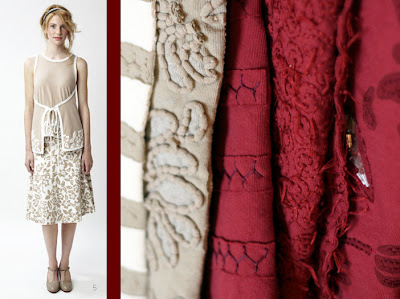
Natalie Chanin from US fashion label Alabama Chanin is a woman with a mission. Every statement on her website proclaims her commitment to creating sustainable products. She uses US made fabrics and employs women throughout her local community to embroider them. Natalie Chanin is also involved in community projects highlighting and strengthening the connection between handmade objects, slow food, small manufacturing plants, recycling, history and communication.
Chanin has produced a documentary on the tradition of quilt making in the American South and as a response the the high price of her handmade couture has also published a book and sells kits so that anyone who can learn the skills to make a beautiful, piece of clothing can afford these lovely, lovely things. Read her blog for an insight into the threads that bind artisans to their community and from there to the wider world.
From Alabama to Australia...... Little Green Dress is the label of my friend Genevieve Edmonds. Genvieve employs local sewers and sources her fabrics from manufacturers using sustainable fibres, reclaiming vantage kimonos (amongst other things) for her beautiful, comfortable clothing.
She says
"At Little Green Dress we want to emphasize the value of quality garments made with attention to detail. Our garments shouldn’t be a throwaway commodity but a cherished and defining staple in your wardrobe which has come into existence with integrity and thought for our planet."

Spotty Cups

Sunday, March 07, 2010

Solving Logistical Problems

I've just finished this Beastie cake plate and set of cups for a special order. The Beastie were inspired by a masterclass I did a few years ago with Marino Moretti in Umbria (it's not like I go to Italy all the time or anything. It was just that I did go once or twice.) The cake plate presented quite a few logistical problems as the shape of a flat plate supported on a raised base is not really suited to porcelain.
I threw the plate first and turned it upside down onto the base and bisque fired it upside down but then I was stuck...... If I fired the cake plate upright the porcelain would slump. San Fransisco potter Whitney Smith offered some excellent suggestions such as grogging the porcelain before I threw the plate and covering the piece with porcelain slip. (unfortunately it was a bit late for that particular bit of good sense), or throwing a concave plate to compensate for the slumping during the gloss firing. I did it the difficult, time- consuming way by throwing a stand to support the plate from underneath and leaving a ring under the cake plate unglazed so the stand could fit exactly under the plate and support it during the firing. This was labour intensive but I now have two stands to use when I am making more cake plates and, very importantly, the plate fired absolutely flat.
All cake bakers will know that a flat cake plate is essential to the success of an afternoon tea!

Friday, March 05, 2010

Canberra Glassworks......working on the wallum


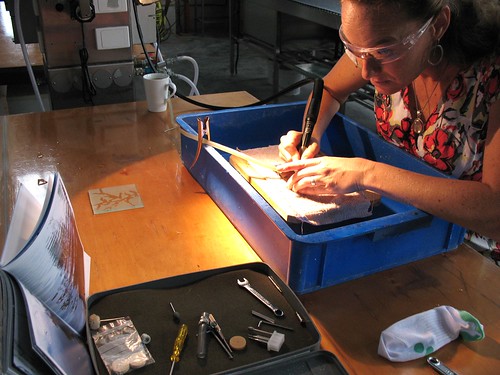
engraving, originally uploaded by rebeccathewrecker.

Rebecca the Wrecker and I have just spent 3 days at Canberra Glassworks doing a masterclass with glass artist and teacher extraordinaire Kirstie Rea. We had an amazing inspiring time.

Canberra Glassworks is a state of the art facility based in an old power station. There are so many workshops covering different aspects of glass forming that we didn't get to see them all, the cold shop, the mold making room and the sandblasters were the ones we concentrated on. Once again we came back to our impressions from the wallum as the source of inspiration and made molds for glass using these.

I was particularly interested in the sandblasting which uses a painterly approach as the resist used is PVA glue. For these little pieces I sandblasted brushbox blossom silhouettes onto the back of "float" glass (common window glass) and used a diamond stylise to etch a drawing into the glass on the opposite side.

Glass engraving is such an immediate way of mark making, the scratchiness of the drawing echoes the twiggy scratchiness of wallum vegetation. I really liked using the window glass as the everyday nature of this material creates a subconscious visual reference linking the glass drawing to windows and all that they represent. The automatic assumption with a window being to look through or out of it, hopefully the viewer of this type of piece would be inexorably drawn towards the drawing to looking closely at and through it!

While we were in Canberra we did a talk for the ceramics students at the Australian National university Ceramics Department. Rebecca and I were struck by the vibrant, international diversity at both ANU and the Glassworks. The place is buzzing with international artists coming and going, Australian artists and students are constantly encouraged to make international connections in terms of residencies and, entering competitions and other professional development programs. It is very exciting for studio artists to be in the hustle and bustle of a creative, institutional atmosphere and I highly recommend anyone thinking of coming to Australia to consider doing a residency or a degree at Canberra Glassworks or ANU.